HEAVY LIFTING
INTERNATIONAL AND SPECIALIZED TRANSPORT
■
DECEMBER 2013
16
This problem isn’t just limited to certain
areas, the situation is occurring all over
the globe. In Japan, for example, crane
rental company Uchimiya has to contend
not only with strict time restrictions and
small construction sites with narrow
roads, but also weight, height and width
restrictions, which can be a tremendous
challenge. “One of our biggest challenges
was the installation of a power reactor at a
petroleum plant in the Tohoku area, Japan”
a company spokesperson tells
IC
. “The
reactor weighed 1,190 tonnes and was 40 m
tall. To complete this difficult task we had
to use three crawler cranes simultaneously;
two Kobelco SL13000s with a lifting
capacity of 800 tonnes and a Kobelco 7800
with a lifting capacity of 750 tonnes.”
Other challenges associated with heavy
lifts include transportation issues, as Mikut
points out, “The biggest challenges with
heavy lifts involve equipment transport.
Planning a load sequence is very difficult;
all the equipment parts have to be in order
so that building and installation goes as
smoothly and as quickly as possible. This
demands a tremendous degree of foresight.
Furthermore, there has to be enough
room on-site, let alone advance ground
preparation, so that we’re able to perform
the lift in question. However, because
preplanning for many lifts is done months
prior to the actual lift the parameters are
constantly changing.”
>
to sit further back from the lifting area,
whereas previously they could sit in closer.
The greater the distance the crane has to sit
from the actual lift site, the stronger it has
to be.”
Kate Lampson from USA-based heavy
lift provider Lampson International, says,
“To overcome confined spaces at refineries,
heavy lift cranes need a small footprint. The
latest model in our fleet is the Lampson
Transi-Lift LTL-3000. This crane has a 121
metre main boom, 36.5 m jib and a 6 m
jiblet. In addition, it has hydraulic hoists,
a larger boom cross section and the wire
rope has been increased from 1 ½ inch to 2
inches [38 to 51 mm].
“Our second largest capacity crawler
crane is our Lampson Transi-Lift LTL-2600.
We most recently used this Transi-Lift
model with 103 m main boom and a 60.9 m
jib with a pick radius of 206 tonnes at
128 m on the expansion of a manufacturing
facility in the Pacific Northwest.”
This need for increased crane capacity
isn’t just limited to end users faced with
smaller working environments; it is also a
requirement for cranes required to handle
the new wave of single piece components.
Heavy lift and transport company, Fagioli,
headquartered in Italy, explains the issue,
“The modularisation of components has
boomed during the last few years, pushing
contractors and clients to build bigger and
bigger modules. This caused a number
of problems for companies in charge of
moving, lifting or installing the pieces,
as single pieces could weigh thousands
of tonnes. This is becoming a kind of
standard, especially in petrochemical
sectors, offshore platforms and drilling
rig towers.”
As suggested by Jerry Maloney,
Manitowoc Cranes global product director,
the trend for ever larger components
is being driven by a number of factors,
including shrinking job site schedules.
“Many petrochemical or energy-related
facilities need upgrading to contend with
increased demand for their product,”
Maloney says. “As a result, up-and-over lifts
are growing, and we are seeing more and
more cranes performing lifts with bigger
radii as they lift huge loads over existing
structures.”
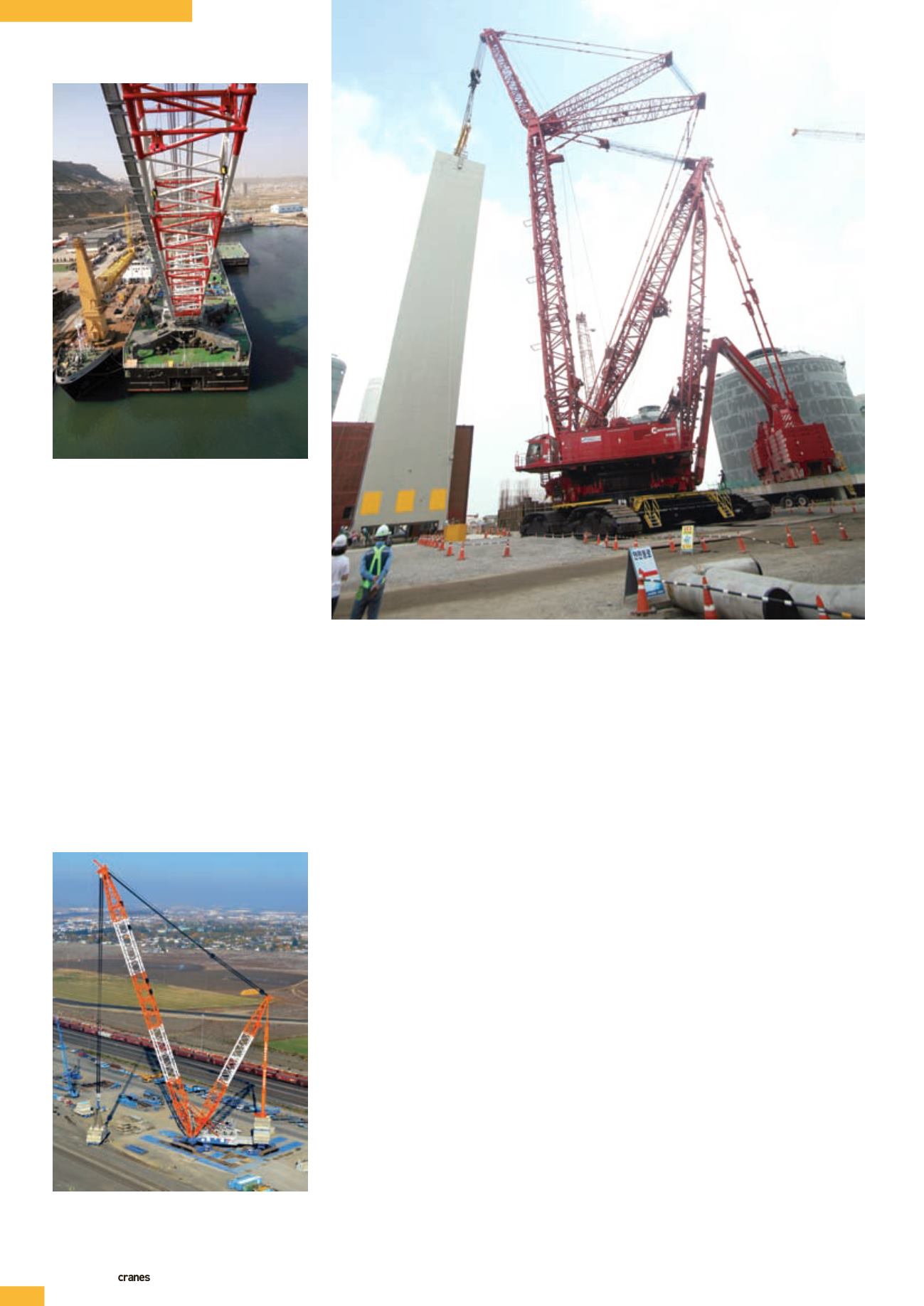
Lampson International’s Lampson Transi-Lift
LTL-3000 undergoing a series of test lifts the
manufacturing facility in Pasco, Washington, USA
The view from the boom
of a Liebherr TCC 14000
A Manitowoc
31000 lifts
a 650 tonne
cold box at
a liquefied
natural gas
plant in
Gwangyang,
South Korea


